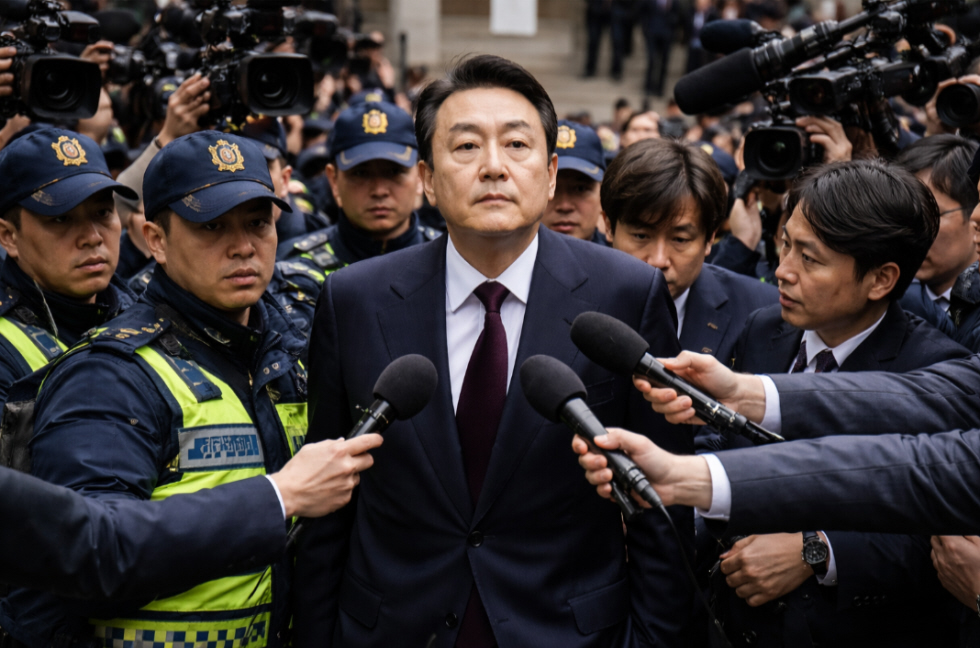
Former South Korean President Yoon Suk Yeol is awaiting a verdict this Thursday in one of the most consequential trials in the country’s recent political history. The Seoul Central District Court is set to rule on charges of insurrection related to his declaration of martial law in 2024, a move that triggered months of political turmoil. Prosecutors argue that Yoon, while serving as president, ordered special military units to surround the National Assembly in Seoul after imposing martial law.
Although lawmakers overturned the decree within hours through an emergency vote, the episode plunged the nation into a prolonged institutional crisis. According to the prosecution, the decision constituted not only an abuse of executive authority but a deliberate attempt to undermine constitutional order. Insurrection is among the most serious charges under South Korean law and carries severe penalties, including the possibility of capital punishment, although the country has observed a de facto moratorium on executions since the late 1990s.
Yoon has defended his actions by claiming he sought to protect the nation’s liberal democratic system from what he described as internal threats. He alleged that segments of the opposition were influenced by hostile foreign forces, though critics have pointed out that no conclusive evidence was presented to support those claims. The trial has drawn significant domestic and international attention due to both the gravity of the accusations and their implications for South Korea’s democratic stability. The country is widely regarded as one of Asia’s most established democracies, with institutions that have endured previous political crises.
Throughout the proceedings, the court heard testimony from senior military officials, government representatives, and constitutional experts. The central question has been whether the declaration of martial law met constitutional requirements or whether it represented a disproportionate and politically motivated action. The ruling will not only determine Yoon’s criminal responsibility but could also establish important precedents regarding the limits of presidential power during states of emergency.
In a political system that depends heavily on the balance between executive and legislative branches, the case may influence future interpretations of emergency authority. The possibility of a conviction has heightened tensions across the country, prompting both supporters and critics of the former president to stage demonstrations. Authorities have strengthened security measures around the courthouse in anticipation of public reactions once the verdict is announced.
Regardless of the outcome, the proceedings underscore the strength of South Korea’s judicial institutions in holding former leaders accountable. In recent decades, several former presidents have faced investigations or convictions, reinforcing the principle that no political figure stands above the law.
The court’s decision on Thursday could mark a defining moment in South Korea’s political landscape. Whatever the verdict, the case has already left a lasting imprint on the nation’s democratic evolution and will likely be remembered as one of its most delicate constitutional tests.