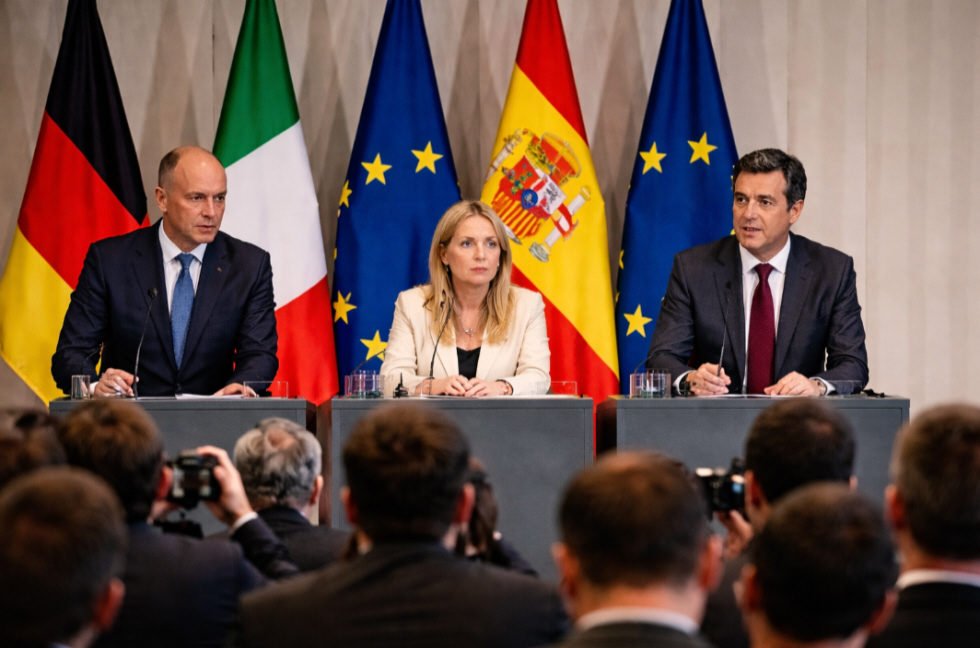
Several European leaders have reacted cautiously to U.S. President Donald Trump’s proposed “Board of Peace” initiative, signaling openness to dialogue while raising constitutional and political concerns about its current structure. Germany and Italy said they could consider participation if the framework were revised, while Spain made clear it would not take part, reaffirming its commitment to the United Nations system.
German Chancellor Friedrich Merz said he would be willing to engage with the initiative if it were explicitly designed to support peace efforts in Gaza. Speaking alongside Italian Prime Minister Giorgia Meloni in Rome, Merz noted that Germany could not accept the board in its present form due to constitutional limitations, particularly regarding its governance model.
He stressed, however, that Berlin remains open to exploring alternative mechanisms of cooperation with Washington aimed at advancing peace in conflict zones. Meloni echoed that position, saying Italy had asked the United States whether the terms of the proposed board could be reconsidered. While she acknowledged that the current statute conflicts with Italy’s constitution, she argued that rejecting the initiative outright would be a mistake.
Meloni emphasized that Italy remains interested and believes it could play a constructive role in efforts to stabilize the Middle East. Spain, by contrast, ruled out participation entirely. Prime Minister Pedro Sánchez said Madrid’s decision was consistent with its long-standing support for multilateralism and the UN framework, adding that the proposed board does not include key actors such as the Palestinian Authority.
Spain, he said, prefers to work through existing international institutions rather than new structures that could sideline them. The initiative has also faced resistance elsewhere in Europe. France and the United Kingdom have indicated they would not join under the current conditions, while Norway, Sweden and Slovenia have formally declined the invitation. Other European governments have yet to provide a definitive response, reflecting broader uncertainty about the board’s role and legitimacy.
Trump unveiled the Board of Peace at the World Economic Forum in Davos, presenting it as an ambitious alternative platform to address global conflicts. He later announced that Canada’s invitation had been withdrawn, while describing the board as an unprecedented gathering of global leaders.
According to its charter, the body aims to restore lawful governance and secure lasting peace in conflict-affected regions, implicitly questioning the effectiveness of existing international organizations. The debate highlights growing divisions over how global peace initiatives should be structured, the role of the United Nations, and whether new forums can complement—or undermine—the established multilateral order.