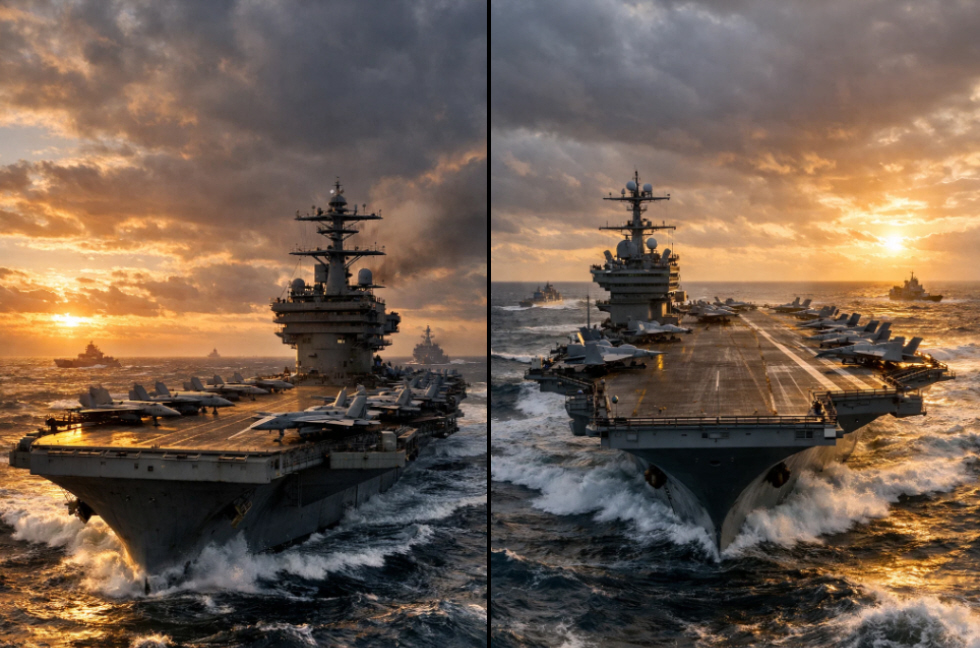
The USS Gerald R. Ford, the most advanced and largest aircraft carrier in the United States Navy, recently departed from Souda Bay in Crete following a logistical stop at the strategic naval and air base in the eastern Mediterranean. The visit to Souda Bay reportedly served for refueling, maintenance, and operational coordination before the carrier strike group continued its deployment toward a region of heightened geopolitical sensitivity.
The ship’s presence in Greece had already drawn attention amid rising regional tensions. The USS Gerald R. Ford leads a powerful strike group that includes guided-missile destroyers and supporting vessels, making it one of the most formidable naval formations currently at sea. Its movement comes at a time of increased uncertainty in the Middle East.
Military assessments suggest the carrier group could reach its operational area within 24 hours, though its final destination has not been officially disclosed. Several potential scenarios remain under consideration. One possibility is that the strike group remains in the eastern Mediterranean, near Israel or the waters surrounding Cyprus, signaling strategic reassurance to regional allies. Another scenario would see the carrier transit the Suez Canal and proceed into the Red Sea or the Persian Gulf, positioning it more directly within the sphere of ongoing tensions between the United States and Iran over nuclear and missile issues.
The deployment unfolds against a backdrop of strained diplomatic relations between Washington and Tehran, marked by public warnings and heightened rhetoric. The USS Gerald R. Ford represents a central pillar of U.S. naval power projection. With the capacity to deploy advanced aircraft and cutting-edge systems, its presence carries a strong deterrent dimension.
The movement of the carrier group also underscores the continued importance of the eastern Mediterranean as a strategic transit corridor for Western forces heading toward the Middle East. International observers interpret the departure from Crete as a signal of operational readiness and flexibility in a region where military balances can shift rapidly.
Although no specific mission has been publicly announced, the repositioning of a platform of this magnitude inevitably influences regional strategic calculations. As the USS Gerald R. Ford advances toward its next operational posture, global attention will remain focused on its trajectory and on Washington’s broader response to evolving tensions in the region.