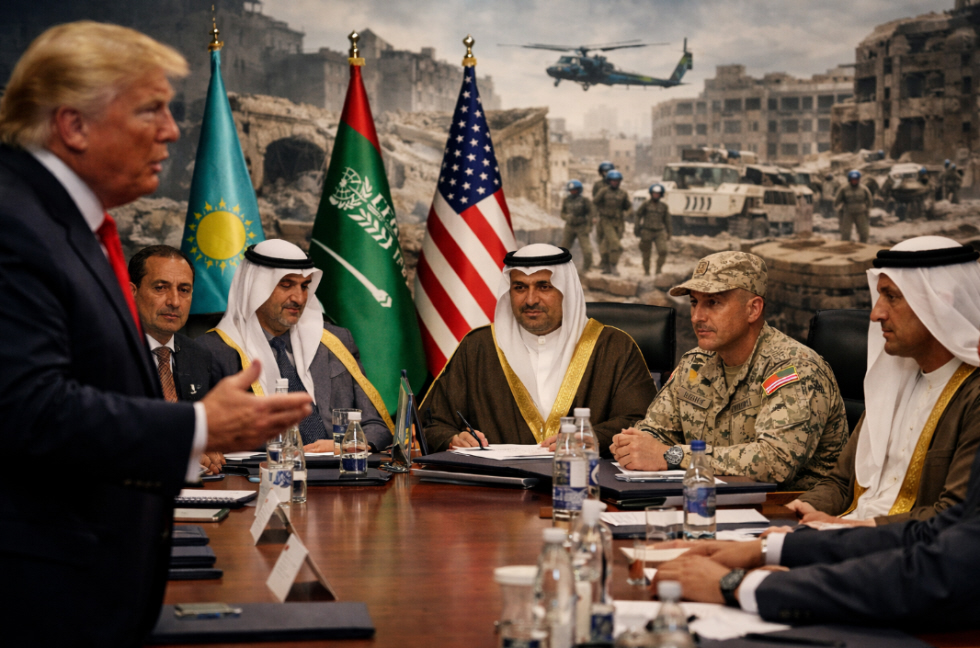
U.S. President Donald Trump announced a multibillion-dollar aid package for the reconstruction of the Gaza Strip during the inaugural meeting of his newly established Peace Council. The initiative aims to coordinate international efforts to stabilize the enclave following months of conflict. Washington pledged ten billion dollars as an initial contribution to the reconstruction fund, positioning the United States as the primary financial driver of the new international framework.
Several Muslim-majority nations also expressed their intention to participate both financially and in the security component of the plan. Collectively, they committed approximately seven billion dollars to support the rebuilding of infrastructure and essential services. The participating countries span the Gulf region, Central Asia, and North Africa, reflecting an effort to assemble a coalition that combines regional legitimacy with substantial economic backing.
A central pillar of the proposal involves the creation of an International Stabilization Force designed to maintain basic security conditions while reconstruction projects move forward. The structure and deployment details remain under development. The U.S. president did not provide specific details regarding the immediate allocation of funds or a precise implementation timeline.
However, he emphasized that restoring critical infrastructure and strengthening local governance mechanisms would be key priorities. The announcement comes amid a highly sensitive political climate, where any initiative related to Gaza carries immediate diplomatic implications across the Middle East and beyond. The newly formed Peace Council seeks to coordinate not only financial assistance but also oversight mechanisms and international cooperation to prevent reconstruction efforts from becoming entangled in political disputes.
For Washington, the initiative represents an attempt to redefine its role in the region through a strategy that blends diplomacy, funding, and multinational security coordination. The ultimate success of the project will depend on sustained cooperation among participating nations and the ability to implement long-term stabilization measures in a historically volatile environment.