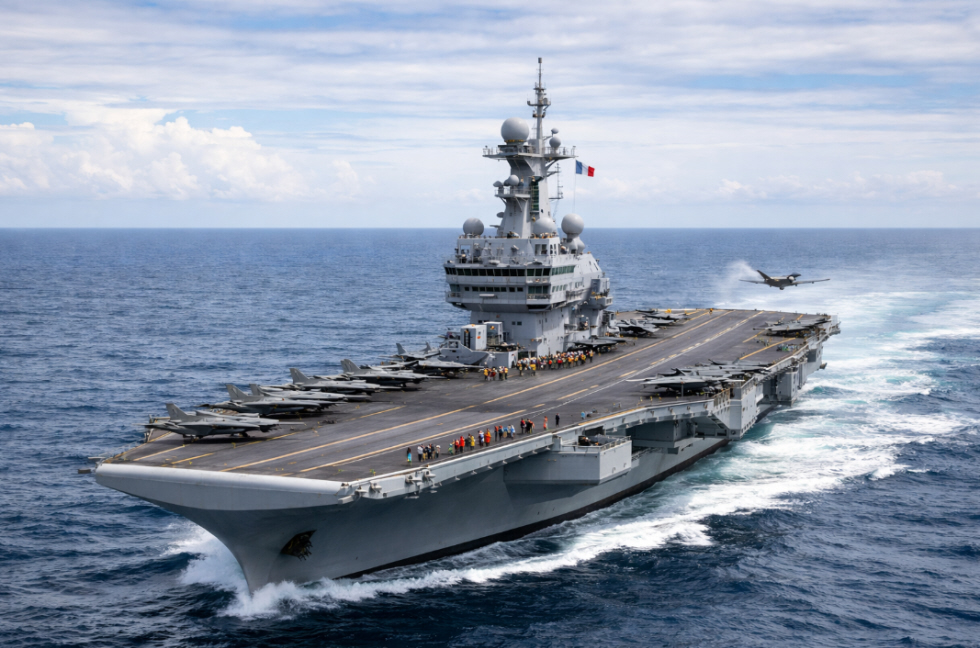
France has taken a major strategic step in strengthening its naval power by confirming the construction of a new nuclear-powered aircraft carrier to replace the current Charles de Gaulle, the flagship of the French Navy. The announcement was made by President Emmanuel Macron during an official visit to the United Arab Emirates, where he addressed French troops and emphasized the need for stronger military capabilities in an increasingly unstable global environment. “In an era of predators, we must be strong in order to be feared,” Macron declared, highlighting the geopolitical rationale behind the decision.
According to the French president, the formal launch of the program was approved this week and aligns with the country’s most recent multi-year military planning laws. The future aircraft carrier, also powered by nuclear energy, is scheduled to enter service in 2038 and will become the largest warship ever built by France. Measuring approximately 310 meters in length and displacing around 80,000 tons, it will be nearly twice as heavy and significantly larger than the Charles de Gaulle, which measures 261 meters and displaces about 42,000 tons.
The vessel is expected to operate with a crew of roughly 2,000 sailors and carry around 30 fighter aircraft, in addition to support aviation, ensuring France retains a fully autonomous capacity for air power projection at sea. Nuclear propulsion will provide exceptional operational endurance, reducing logistical constraints and reinforcing France’s ability to deploy its navy across vast distances. Preliminary work has already begun at facilities operated by Naval Group in Cherbourg, where initial technical preparations have been carried out.
Under the current timeline, the first steel cutting is expected to take place around 2031 in Saint-Nazaire, near the Chantiers de l’Atlantique shipyards, with the main construction phase lasting between four and five years, followed by extensive outfitting and testing. The total cost of the program is estimated at approximately €10 billion, reflecting both the technological complexity of the ship and the scale of France’s long-term strategic ambitions.
Beyond its military significance, the project is also expected to provide a substantial boost to the French defense and shipbuilding industries, mobilizing thousands of engineers, technicians, and companies over more than a decade. With this new aircraft carrier, France aims to secure its position as one of the world’s leading military powers, maintaining credible naval deterrence and global reach at a time when great-power rivalries are once again shaping international relations.