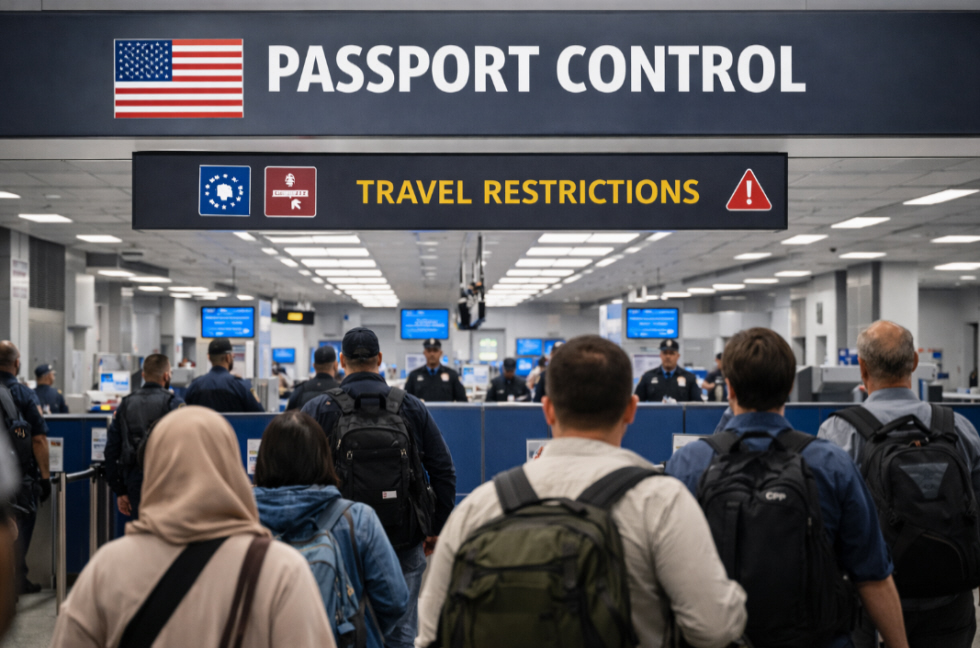
The administration of President Donald Trump has expanded the list of countries whose citizens are barred from entering the United States, adding five more nations: Burkina Faso, Mali, Niger, South Sudan and Syria. The decision is part of a broader review of US immigration and national security policies, which the administration says is based on concerns related to identity verification, security cooperation and institutional stability in the affected countries.
In addition to the full entry bans imposed on these five states, fifteen other countries have been placed under partial travel restrictions, limiting access to certain visa categories or subjecting travelers to additional screening requirements. At the same time, the new measures prohibit entry to individuals holding travel documents issued by the Palestinian Authority, a move that reinforces an already highly restrictive framework that has, in practice, made it extremely difficult for Palestinians to obtain US visas.
With this latest expansion, a total of 39 countries are now subject to some form of travel restriction to the United States. The Trump administration has defended the policy as a necessary step to strengthen border security and ensure greater control over immigration flows, emphasizing the sovereign right of nations to determine their own entry requirements in line with national interests.
The announcement has renewed international attention on the political and humanitarian implications of such measures, particularly for regions affected by armed conflict, prolonged instability or humanitarian crises. While US officials maintain that the restrictions are not directed at specific populations but rather at state systems deemed insufficient under US standards, international organizations and diplomatic actors have often warned that broad travel limitations can carry diplomatic and humanitarian consequences.
The policy shift comes amid a global environment marked by heightened geopolitical tensions and increasingly restrictive migration policies worldwide. As the list of affected countries grows, attention is now focused on how these decisions may influence bilateral relations, migration patterns and the ongoing balance between national security priorities and humanitarian considerations, a debate that continues to generate differing views both within the United States and internationally.