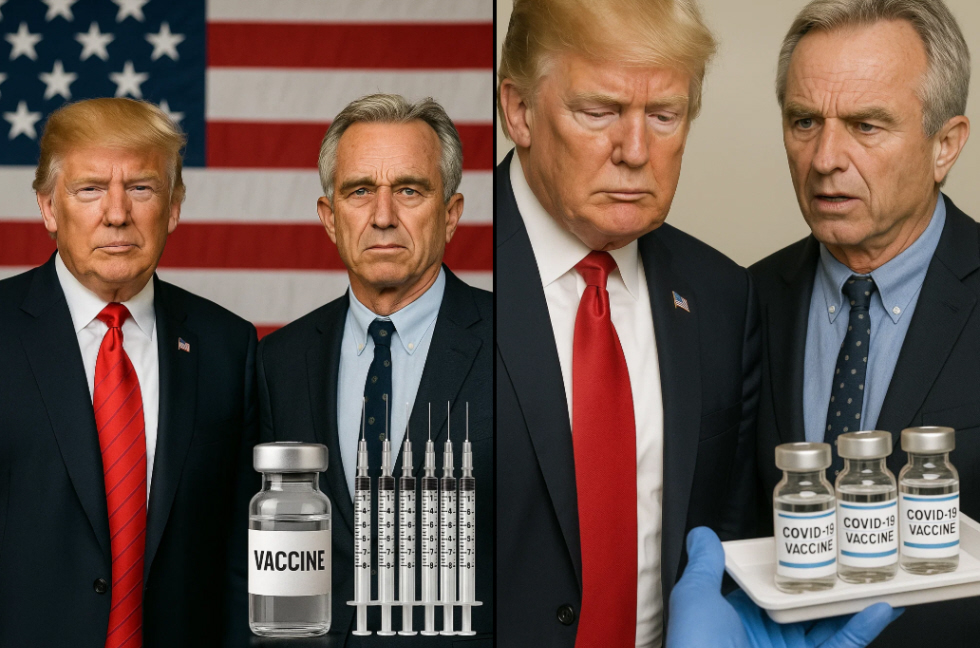
President Donald Trump has doubled down on his support for Health Secretary Robert F. Kennedy Jr., despite growing criticism from lawmakers, scientists, and public health organizations over Kennedy’s controversial vaccine policies. Kennedy, long known for his skepticism toward vaccines, has moved aggressively since taking office by cutting federal funding for vaccine research, limiting access to COVID-19 vaccines, and dismissing the director of the Centers for Disease Control and Prevention.
These measures have triggered widespread concern about the potential resurgence of preventable diseases, including measles and polio, at a time when vaccination rates are already under pressure worldwide. Public health experts warn that Kennedy’s stance undermines decades of progress in disease prevention and could lead to severe outbreaks. International partners, including the World Health Organization, have expressed alarm at the shift in U.S. policy, arguing that Washington’s leadership is crucial for maintaining global vaccination programs.
Domestically, bipartisan voices in Congress have criticized the administration, with Democrats accusing Trump of endangering children’s health and some Republicans worried about the political fallout of aligning with anti-vaccine rhetoric. Despite these warnings, Trump has repeatedly defended Kennedy in public, describing him as a “truth-teller” who is unafraid to challenge entrenched institutions. At a recent rally, Trump praised Kennedy’s “courage to speak against powerful pharmaceutical interests,” framing him as a reformer who prioritizes individual freedom over government mandates.
This message resonates with segments of Trump’s base who distrust mainstream science and federal agencies, reinforcing the president’s populist appeal. Kennedy’s rise to the nation’s top health position was itself unusual. After endorsing Trump during the 2024 election and spearheading the “Make America Healthy Again” movement, Kennedy became a symbol of Trump’s willingness to reward loyalty and embrace outsiders.
During his Senate confirmation hearings, Kennedy faced fierce questioning about his views, with senators pressing him on whether his policies would increase public health risks. Though his answers did little to reassure critics, Trump immediately voiced full confidence in his appointee, insisting that Kennedy “means well” and that alternative perspectives should be given space in government decision-making. The political risks, however, are significant.
Polls show that while some voters appreciate Kennedy’s independence, a majority express concern about the administration’s vaccine policies. Analysts warn that Trump’s continued embrace of Kennedy could alienate moderate voters in key swing states, particularly parents who rely on vaccines for their children. Still, for Trump, the calculation appears clear:
Kennedy represents not just a health secretary, but a cultural symbol of defiance against the establishment. As the debate intensifies, the U.S. stands at a crossroads in public health policy. Whether Trump’s gamble will pay off politically—or whether Kennedy’s tenure will be remembered for undermining America’s vaccination infrastructure—remains one of the most consequential questions facing the administration.