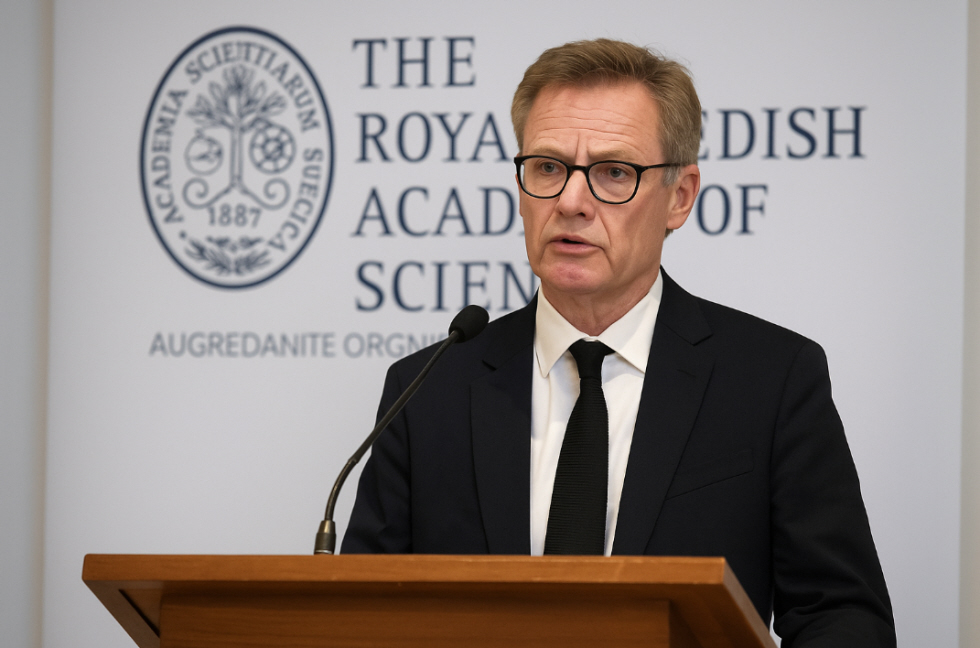
No other country in the world has produced as many Nobel Prize winners as the United States, a nation long regarded as the engine of global scientific progress. But researchers from the Royal Swedish Academy of Sciences, the institution responsible for awarding the Nobel Prizes in Physics, Chemistry, and Economics, warn that this leadership is now at risk due to former President Donald Trump’s policies.
According to Hans Ellegren, Secretary General of the Academy, Trump’s actions — including deep funding cuts, restrictions on academic freedom, and mass dismissals of scientists from federal agencies — are undermining the very foundations that made American scientific success possible. “Long-term investment in basic research and the independence of universities have ensured the country’s position as a scientific leader.
If those foundations are weakened, the nation’s status is threatened,” Ellegren said. Since January, the National Institutes of Health (NIH) have awarded over 2,100 research grants totaling $9.5 billion, along with contracts worth an additional $2.6 billion, according to data from Grant Watch. However, several key programs — including studies on cancer, Alzheimer’s, and the health impacts of climate change — have been affected by funding freezes.
Trump has also sought to restrict research on vaccines, climate science, social justice, and inclusion, sparking alarm across the academic community. Thomas Perlmann, Secretary of the Nobel Committee for Medicine, described the United States as “the true engine of global science” but warned that uncertainty is growing. “It doesn’t take many years of major cuts to cause irreversible damage,” he said.
The scientists fear that such policies could trigger an exodus of researchers, harming not only the United States but also international scientific collaboration. Ellegren noted that once scientists lose their positions or funding, many never return to their fields, even if budgets recover later. “There is a real risk that we could lose an entire generation of young researchers,” he warned. The impact is already being felt globally. The NIH, once a key supporter of international research projects, has scaled back its global partnerships.
“Any nationalist or isolationist regulation of academic work makes it harder to share ideas and data — the very essence of science,” Ellegren emphasized. “Research is inherently global; it thrives on the free exchange of knowledge and collaboration.” Meanwhile, China is rapidly emerging as a major scientific power, investing heavily in technology, medicine, and innovation.
“The Chinese government is putting extraordinary sums into science,” Ellegren acknowledged, though he stressed that the U.S. remains dominant for now. This year, two of the three Nobel Prize winners in Medicine are based in the United States, and the Physics Prize went to a team including an American, a Briton, and a French scientist — all conducting research in California.
Still, the message from the Swedish Academy is clear: without a renewed commitment to scientific freedom and sustained investment in research, even the most decorated nation in Nobel history could see its leadership role in global science begin to fade.