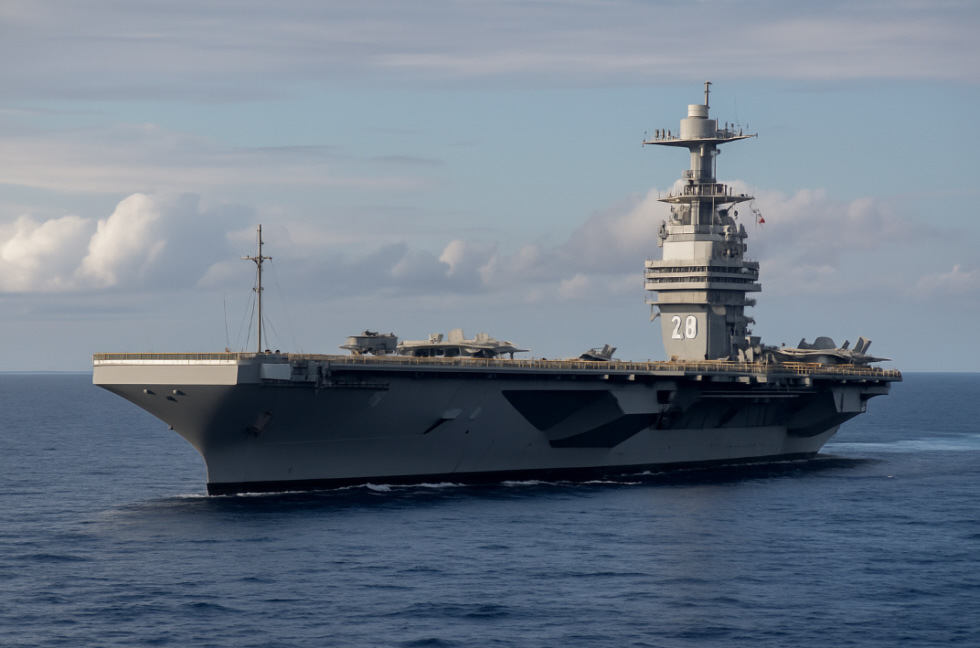
The world’s largest aircraft carrier, the USS Gerald R. Ford, is currently sailing somewhere in the Caribbean Sea or near the coasts of Latin America, according to Pentagon officials who have not disclosed its exact location. The U.S. Navy flagship, stretching 333 meters in length and capable of carrying up to 90 combat aircraft and several thousand personnel, has been withdrawn from the Mediterranean and reassigned to the U.S. Southern Command (SOUTHCOM) area of operations.
A relocation with a reserved message
Officially, Washington describes the move as part of ongoing efforts to combat transnational drug trafficking and enhance maritime security in the region — operations often conducted in coordination with local authorities and international partners. Still, the timing of the redeployment has drawn attention, coming amid delicate diplomatic tensions in parts of Latin America, particularly Venezuela, prompting a climate of caution and close observation among neighboring countries. While the Pentagon confirmed the carrier’s redeployment, it declined to specify its coordinates, emphasizing that the measure follows a scheduled strategic rotation under SOUTHCOM, whose jurisdiction extends across the Caribbean, Central America, and South America.
Operations and regional context
In recent weeks, U.S. forces have reported interdiction operations against illicit trafficking in the Caribbean and Eastern Pacific, including the boarding of vessels suspected of carrying narcotics. Some of these actions have sparked international debate over transparency and legal frameworks, leading multilateral organizations to call for restraint and clarity in future maritime operations.
Reactions in Venezuela and neighboring countries
Meanwhile, Venezuela has launched a large-scale defense drill known as “Plan Independencia 200,” involving its army, air force, navy, and civilian militia units to strengthen national readiness. The Venezuelan Defense Ministry characterized the exercises as strictly defensive, aligned with the nation’s policy of sovereignty and territorial integrity. Neighboring countries, including Colombia and Brazil, have expressed measured concern and are monitoring developments closely, stressing the importance of dialogue and regional stability.
Technology and symbolism
The USS Gerald R. Ford represents the new generation of U.S. nuclear-powered aircraft carriers, featuring an advanced reactor, extended autonomy, and the ability to conduct a wide range of air operations. Seen as both a technological milestone and a symbol of maritime presence, its undisclosed position underlines the sensitive geopolitical atmosphere currently surrounding the region.