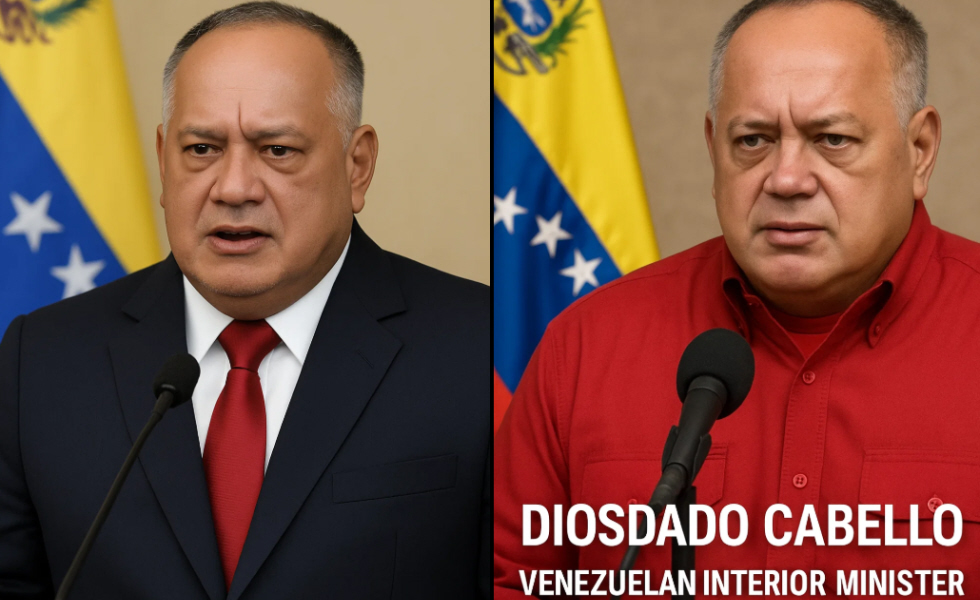
Venezuela’s Minister of Interior, Justice, and Peace, Diosdado Cabello, responded to growing international accusations labeling his country as a “narco-state” and insisted that such claims are part of a political campaign aimed at promoting regime change. In statements broadcast on state television, Cabello asserted that Venezuela “remains a territory free of illicit crops” and that the allegations made from the United States lack any real foundation.
The ruling party leader stressed that the drug trafficking accusations are intended to discredit Nicolás Maduro’s government and to justify military and diplomatic pressure against Caracas. According to Cabello, the deployment of U.S. warships in the Caribbean and off Venezuela’s coasts does not respond to a legitimate interest in fighting drug trafficking, but rather to what he described as a “brutal campaign of psychological warfare” meant to intimidate the population and foster internal divisions.
In his remarks, he also denounced that Washington maintains a systematic strategy of sanctions, threats, and harassment to portray Venezuela as a hub of criminal operations, when in reality—according to his version—the country has complied with international commitments regarding drug control. “We are not, and will never be, a drug-trafficking country. Coca is not cultivated here, and cocaine is not produced here.
The evidence they use to attack us is part of a dirty war,” the minister stated. The context in which these statements are made is marked by rising tensions between Caracas and Washington. The United States recently doubled the reward for information leading to the arrest of Nicolás Maduro and key figures of his government, including Cabello himself, whom they accuse of being part of the so-called “Cartel of the Suns,” an alleged network of military and politicians linked to drug trafficking.
Caracas categorically rejects this narrative and maintains that the true aim of these measures is to create conditions to overthrow the Bolivarian government. In addition to denying any connection to illicit activities, Cabello called on the Venezuelan population to remain united in the face of what he defined as a direct attack on national sovereignty. “What they want is to divide us and wear us down, but the people of Venezuela have the strength and the awareness to defend themselves,” he said, while reiterating the support of the Bolivarian Militia and the National Armed Forces in defending the homeland.
With these statements, the minister reinforces the official Chavista narrative, framing the drug trafficking accusations and foreign military operations as part of a broader plan of political intervention. The speech adds to Nicolás Maduro’s warnings, who days earlier mobilized millions of militiamen in response to the presence of U.S. destroyers in the region. Both leaders agree that Washington’s real objective is not to fight drug trafficking, but to weaken the Venezuelan government and push for regime change through non-democratic means.