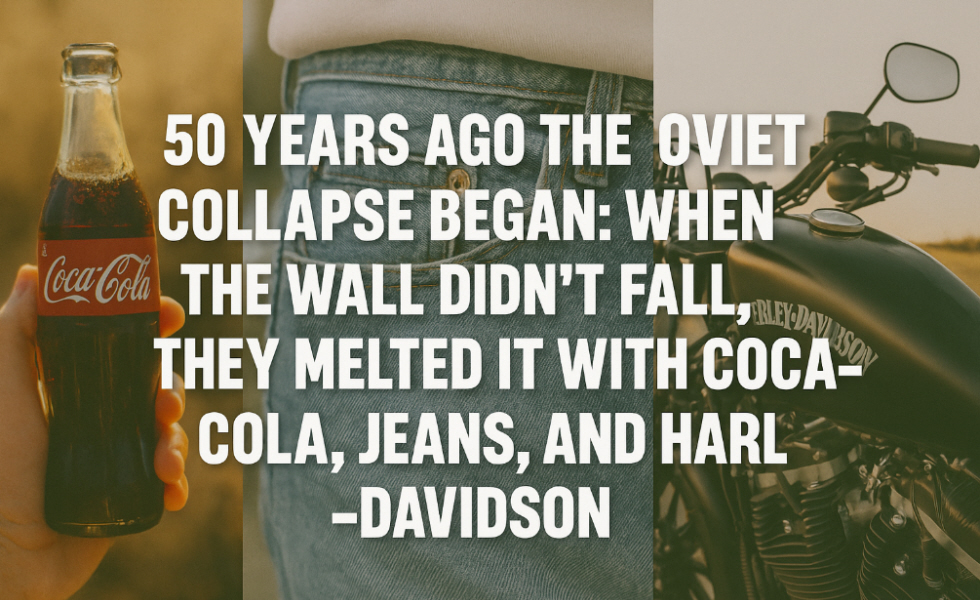
Fifty years ago, the powerful Soviet Union began to show deep cracks that, over time, would lead to its ultimate collapse. However, this downfall was not only the result of an inefficient economic model or suffocating political repression. The West—especially the United States—knew how to play a silent yet effective game: it didn't invade the USSR with tanks, it did so with Levi’s jeans, Coca-Cola, and Harley-Davidson motorcycles.
A Cold War with Cultural Heat
While Soviet citizens stood in endless bread lines and lived under the watchful eye of the State, the Western world radiated freedom, consumption, and pop culture. The United States didn’t export weapons to the USSR—it exported desire. The desire to live like those on the other side of the Wall, to access a world where people could choose what to wear, what to eat, what to listen to… and what to dream. Rock and roll music, Hollywood films, fashion magazines, and even TV commercials became messages filled with an irresistible promise. In a closed-off world, these filtered icons were emotional dynamite.
The Battle of the Blue Jeans
One of the most powerful examples was the Levi’s jean. Officially banned but fiercely desired, blue jeans became a symbol of youth rebellion and modernity. On the black markets of Moscow, a pair of Levi’s was worth more than an engineer’s monthly salary. They were more than clothes—they were a flag of freedom.
Collapse from Within (and Without)
At the same time, the Soviet internal structure was crumbling. Its planned economy was rusting, its technology outdated, and its citizens exhausted. The invasion of Afghanistan marked the beginning of the end: an expensive and unpopular war that drained vital resources. Meanwhile, Ronald Reagan’s administration in the U.S. pushed the USSR into an unsustainable arms race. And as the regime tightened its grip, the people dreamed of hamburgers, freedom of speech, and blue jeans.
When the West Won Without Firing a Bullet
The fall of the Berlin Wall in 1989 symbolized the end of the Soviet regime, but in reality, it was the final chapter of a process that had begun decades earlier. The West didn’t destroy the USSR with bombs—it did it with culture. It chose seduction over conquest. Its most powerful weapon was showing an alternative life: attractive, abundant, and free. And so, fifty years ago began a silent revolution—not of gunpowder, but of symbols.
Of Coca-Cola versus vodka, Harley-Davidson versus the Lada,
and MTV versus state propaganda. The people chose to dream differently. And among all those symbols of individual freedom, we cannot forget the Ray-Bans—the sunglasses that became a global icon of rebellion and style. In the 1980s, Hollywood films turned them into a cult brand, and their arrival in the clandestine shop windows of the East was as coveted as any garment of freedom. For many young Soviets, wearing a pair of Ray-Bans was not just a fashion statement, but a silent act of defiance against the system.
🇷🇺 50 Años de la Caída de la URSS: Cuando la Cultura Venció a un Imperio
🎙️ Artículo de Opinión | 🕊️ Reseña Histórica | 📻 G1Radio.com
🔊 Escucha cómo unos jeans, una Coca-Cola y unos Ray-Ban ayudaron a cambiar la historia.