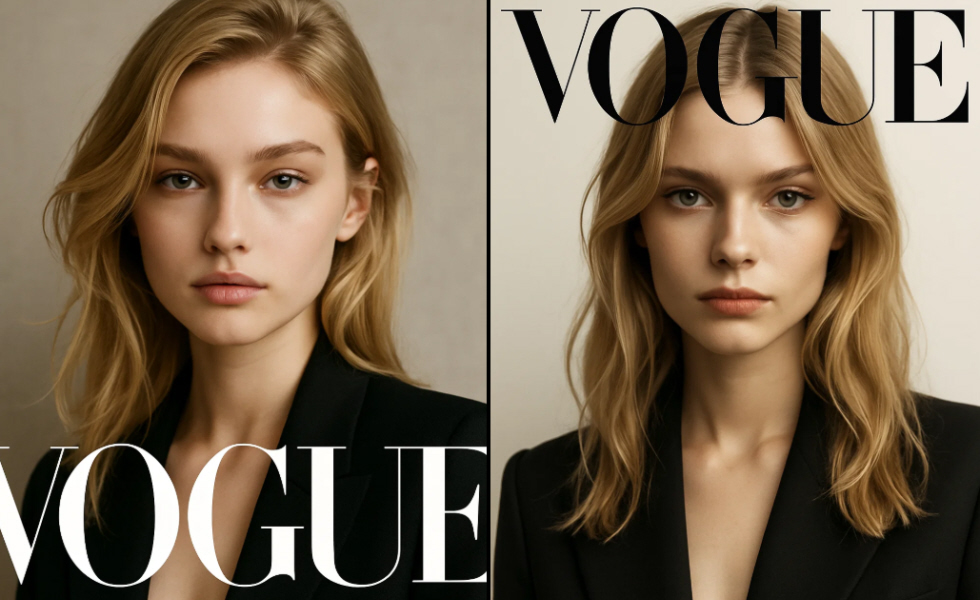
The fashion industry has taken an unexpected turn by embracing artificial intelligence tools not just as visual support, but as the main protagonists of advertising campaigns. This was demonstrated by the renowned magazine Vogue, which, in its August 2025 issue, included for the first time in its history a graphic campaign featuring a model entirely generated by AI.
The image—striking, hyper-realistic, and designed with photographic precision—depicts a blonde woman with blue eyes and flawless skin, wearing pieces from Guess’s summer collection. However, the model does not exist: she is a digital creation made by the tech studio Seraphinne Vallora, based in New York. The technical process behind this digital figure was not a mere filter or casual render.
It was a professional production involving 3D facial modeling, fabric and texture generation through algorithms trained on contemporary fashion, and lighting simulated in digital environments. Advanced visual generation systems similar to Stable Diffusion or DALL·E were used, with human intervention for wardrobe design and posing. The result was so convincing that many readers didn’t even notice.
Only a small footnote revealed that the image was AI-generated. According to the creators, Valentina González and Andreea Petrescu, the campaign took about a month to produce, involving five professionals in digital art, programming, fashion, and post-production. The final cost exceeded six figures. “Our goal wasn’t to replace anyone, but to explore new ways of visual storytelling,” they explained in an interview with computational design media.
Still, the tech and art communities are already debating the deep implications of this breakthrough. While it’s both an aesthetic and technical achievement, it also raises questions about ethical boundaries, intellectual property, and the automation of creative professions.
The ability to create perfect models in minutes—without contracts, casting, or traditional production—could radically transform the advertising business. Some see this as an opportunity to democratize digital fashion; others, as a direct threat to the livelihoods of thousands of human creatives. Beyond the controversy, Vogue has set a precedent. Artificial intelligence is not just designing images: it is now starring in campaigns. And whether we like it or not, this is just the beginning.