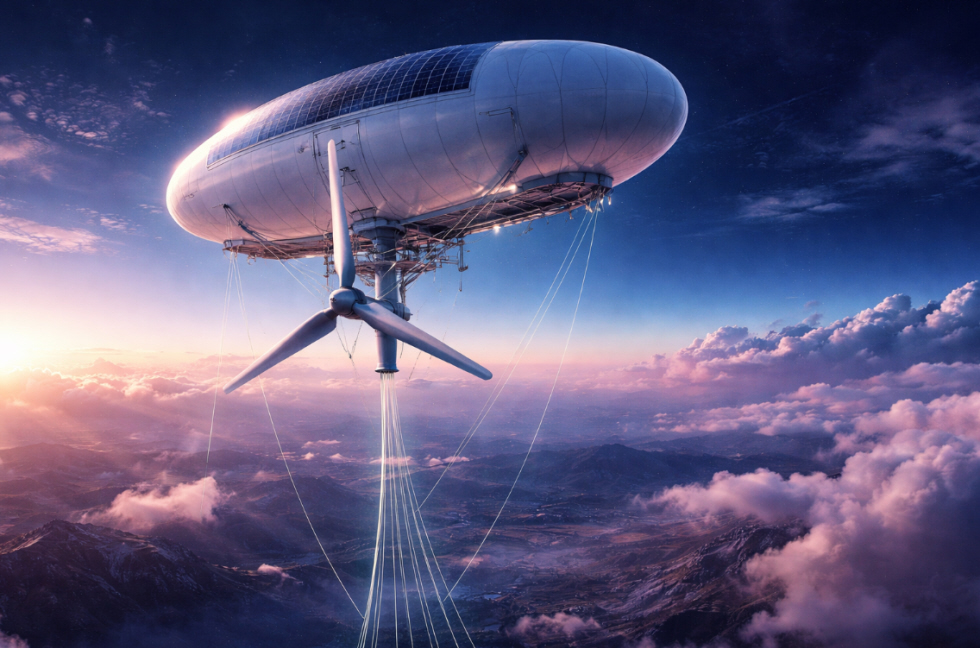
China has successfully tested an experimental high-altitude power generation system based on a helium-supported wind turbine, marking a notable step forward in advanced renewable energy development. The device, measuring approximately 60 meters in length, was lifted to an altitude of around 2,000 meters to evaluate its performance under real-world conditions.
Unlike traditional wind farms installed on land or offshore, this system aims to harness stronger and more stable wind currents found at higher elevations. In theory, these upper-level winds provide more consistent and predictable energy output. During the test phase, the airborne system generated an average of 385 kilowatts over a 30-minute period. While still experimental, the results suggest the concept could complement existing renewable energy infrastructure if successfully scaled. The design combines a lightweight wind turbine with a helium-filled structure that keeps it suspended in the air, connected to the ground through tethering cables that transmit the electricity produced.
This configuration eliminates the need for massive steel towers and permanent foundations. One of the model’s main advantages is flexibility. Without relying on fixed heavy structures, the system could potentially be deployed in remote or difficult-to-access regions and relocated when necessary. Operating at high altitude may also reduce certain environmental impacts commonly associated with conventional turbines, such as ground-level noise and visual disruption.
However, questions remain regarding airspace regulation, long-term maintenance, and resilience under extreme weather conditions. System stability remains a central challenge. At 2,000 meters, turbulence, storms, and temperature fluctuations could influence performance and structural integrity, requiring advanced control and monitoring technologies.
High-altitude wind energy has been explored for years as a way to increase efficiency beyond the limits of conventional turbines. Several countries are researching similar concepts, though few have advanced to large-scale real-world testing. For China, the development aligns with its broader strategy to diversify energy sources and lead in clean technology innovation.
The country has already made substantial investments in solar and wind infrastructure and continues expanding into next-generation solutions. Although still in the developmental stage, the successful trial signals a new chapter in renewable engineering. If technical and regulatory hurdles can be addressed, high-altitude wind systems may eventually become a complementary component of the global energy mix.