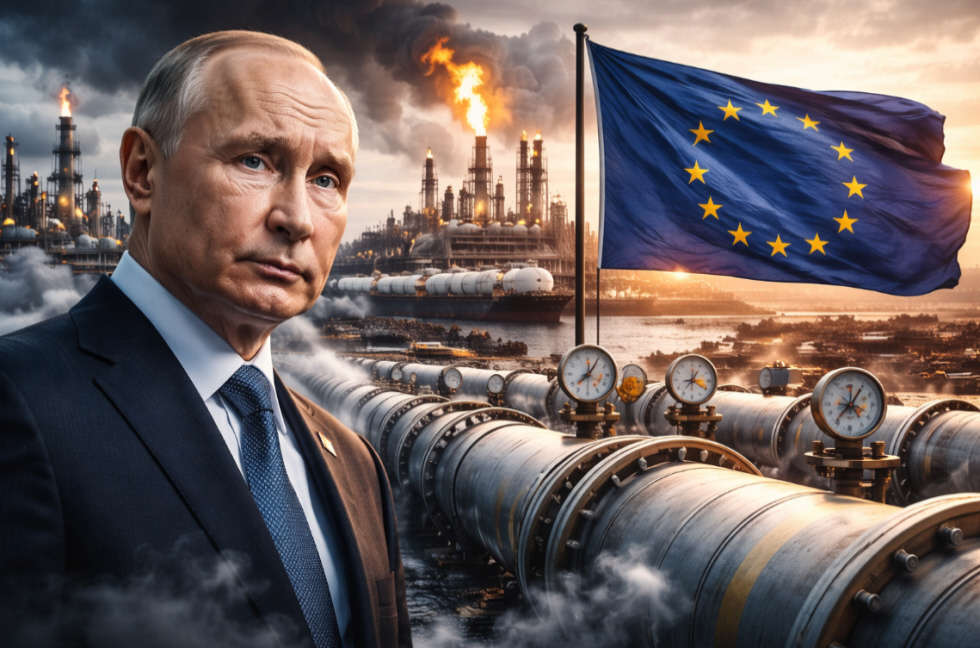
The global energy crisis has intensified once again after new remarks from Russian President Vladimir Putin regarding the future of gas supplies to Europe. Amid growing tensions linked to the Iranian conflict and broader geopolitical pressures, the Kremlin signaled that Russia may consider cutting gas deliveries to the European Union sooner than expected. In an interview broadcast on Russian state television and later released by the Kremlin, Putin indicated that Moscow is seriously evaluating the possibility of halting gas shipments to European markets.
According to the Russian leader, current global developments are opening new opportunities for the country to redirect its energy exports. Putin stated that “other markets” are emerging as attractive alternatives for Russian natural gas. In that context, continuing to supply large volumes of energy to Europe may no longer represent Russia’s most advantageous strategy. The statement comes at a particularly sensitive moment for relations between Russia and the European Union.
Over recent years, the EU has been working to reduce its dependence on Russian energy supplies amid ongoing political tensions. Brussels has announced a long-term plan to completely phase out imports of Russian natural gas by the end of 2027. The initiative is part of a broader strategy to diversify energy sources and strengthen the continent’s long-term energy security. Faced with this scenario, Moscow appears to be considering moving ahead of European policy decisions. By cutting supplies earlier, Russia could reshape its energy strategy and increase pressure on global energy markets.
Analysts warn that such a move would have immediate consequences for international gas prices. Despite diversification efforts, parts of Europe still rely on Russian energy flows, making the region vulnerable to sudden disruptions. At the same time, Russia has intensified efforts to expand its energy partnerships across Asia and other regions.
Countries such as China, India, and several emerging economies are increasingly seen as alternative destinations for Russian gas exports. This shift reflects a broader transformation in global economic and geopolitical alliances.
Energy continues to serve as one of the most powerful strategic tools in international competition among major powers. Meanwhile, Europe is accelerating its transition toward alternative suppliers and renewable energy sources. The outcome of this evolving standoff between Moscow and Brussels could reshape the continent’s energy landscape for years to come.