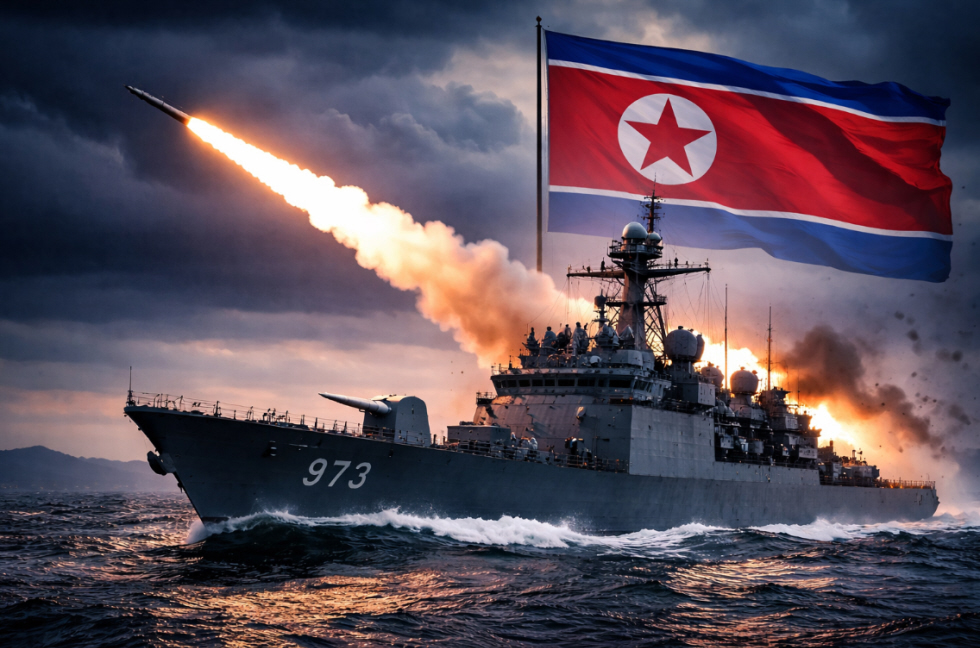
North Korean leader Kim Jong Un personally oversaw new naval weapons tests this week, highlighting the country’s growing focus on expanding its maritime military capabilities. According to reports released by state media, the exercises involved the testing of a naval destroyer along with missile launches designed to demonstrate new strategic capabilities. The tests are part of a broader effort by Pyongyang to modernize its navy and strengthen its overall defense posture.
During the exercises, Kim declared that the country is moving forward with plans to arm its naval forces with nuclear-capable systems. The announcement signals a potential shift in North Korea’s military doctrine, with greater emphasis placed on maritime operations and sea-based strategic deterrence. Among the drills conducted during the tests was the launch of a sea-to-surface cruise missile.
This type of weapon is designed to strike land targets from naval platforms, expanding the operational reach of a country’s armed forces beyond its immediate territory. The demonstration also served as a public display of North Korea’s continued commitment to strengthening its military power despite international pressure and sanctions. The tests came shortly after the conclusion of a major congress of the ruling Workers’ Party, a political gathering that takes place roughly once every five years and helps define the country’s strategic direction.
During the congress, Kim Jong Un reaffirmed his government’s commitment to expanding the country’s military capabilities and accelerating the development of advanced weapons systems. In recent years, North Korea has significantly increased the pace of its weapons development programs. These efforts include long-range ballistic missiles, hypersonic systems and submarine-based launch platforms. Integrating nuclear capabilities into naval forces would represent another step in the evolution of the country’s strategic arsenal.
Analysts believe such developments aim to diversify launch platforms and strengthen deterrence capabilities. Sea-based weapons systems can provide greater survivability in the event of conflict by dispersing strategic assets across multiple operational environments. North Korea’s weapons tests frequently draw concern from neighboring countries, particularly South Korea and Japan, which closely monitor every advancement in Pyongyang’s military technology.
With these latest naval exercises, North Korea appears determined to continue strengthening its military posture while signaling that it intends to respond forcefully to what it perceives as external threats.