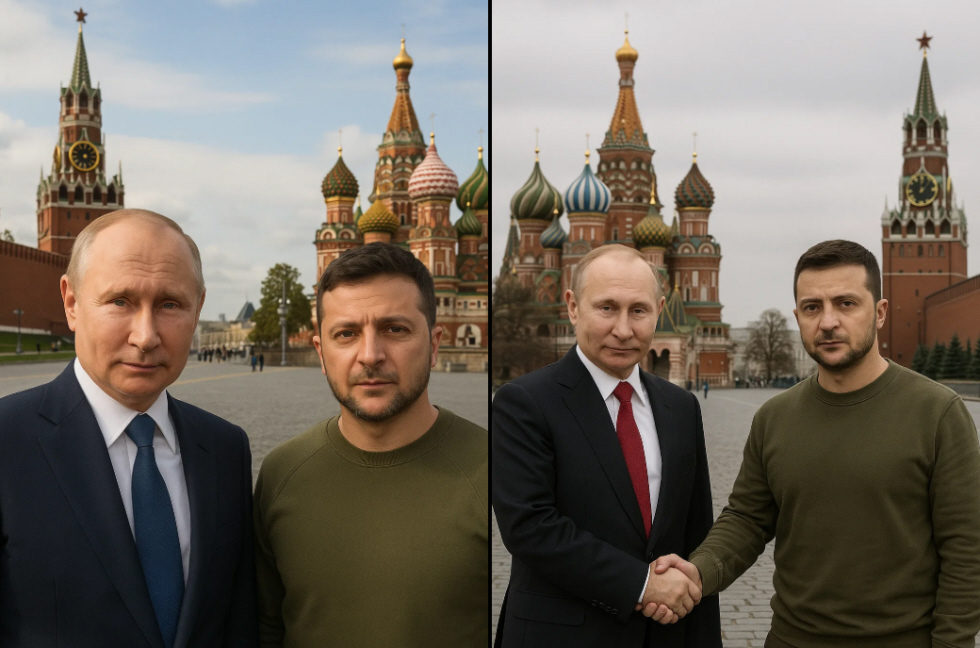
The war in Ukraine, now dragging on for more than three and a half years, shows no clear signs of ending soon. Against this backdrop, Russian President Vladimir Putin again hinted at the possibility of a direct meeting with his Ukrainian counterpart, Volodymyr Zelensky, but conditioned such an encounter on it taking place in Moscow. The proposal, widely seen as symbolic and not entirely serious, was rejected by Zelensky, who issued a counteroffer:
“He can come to Kyiv,” the Ukrainian leader said in an interview with ABC News. Zelensky stressed that it was unthinkable for him to travel to Moscow while his country is under daily attack and enduring constant aggression. The Ukrainian president has repeatedly called for a direct meeting with Putin to negotiate a ceasefire or at least establish the basis for a peace process.
According to Ukrainian sources, at least seven countries have offered themselves as neutral hosts for such a summit, including Turkey and several Gulf states recognized for their balanced stance in the conflict. Austria also joined the list, with Chancellor Christian Stocker proposing Vienna as a potential location for the talks. Nevertheless, the likelihood of such negotiations materializing remains uncertain. Putin, for his part, has reiterated that he would only receive Zelensky in Moscow
“if there were prospects of a good outcome,” a condition many analysts view as a strategy to strengthen the Kremlin’s bargaining position on its home ground. Speaking at an economic forum in Vladivostok, the Russian president once again questioned Zelensky’s legitimacy as head of state, asserting that his mandate should not be recognized. These remarks highlight Moscow’s inflexible stance and its belief that it maintains an advantage both on the battlefield and in the political arena. Meanwhile, Ukraine continues to report severe humanitarian violations in occupied territories.
Andriy Yermak, head of the presidential office, announced the return of a large group of Ukrainian children who had been abducted during the Russian occupation. According to Yermak, the children endured repression, coercion, and exposure to Russian propaganda, with some forced to sing the Russian anthem and participate in military-themed events. One teenager, he said, had even been recruited into military service despite suffering from health problems.
Reports also indicate that some mothers were humiliated for refusing to send their children to events organized by the occupying authorities. These revelations have prompted condemnation from international organizations and human rights groups, which regard the abduction and indoctrination of minors as a war crime. For Kyiv, the safe return of these children represents a major humanitarian achievement but also underscores the scale of abuses still occurring in areas under Russian control. In this complex environment, the possibility of a meeting between Putin and Zelensky appears distant and riddled with obstacles.
Mutual distrust, conflicting interests, and the absence of minimum security conditions make any diplomatic breakthrough uncertain. Yet the very discussion of a potential encounter reflects the growing international pressure to open channels of dialogue in a conflict that has not only devastated Ukraine but also reshaped the geopolitical landscape of Europe and the wider world.