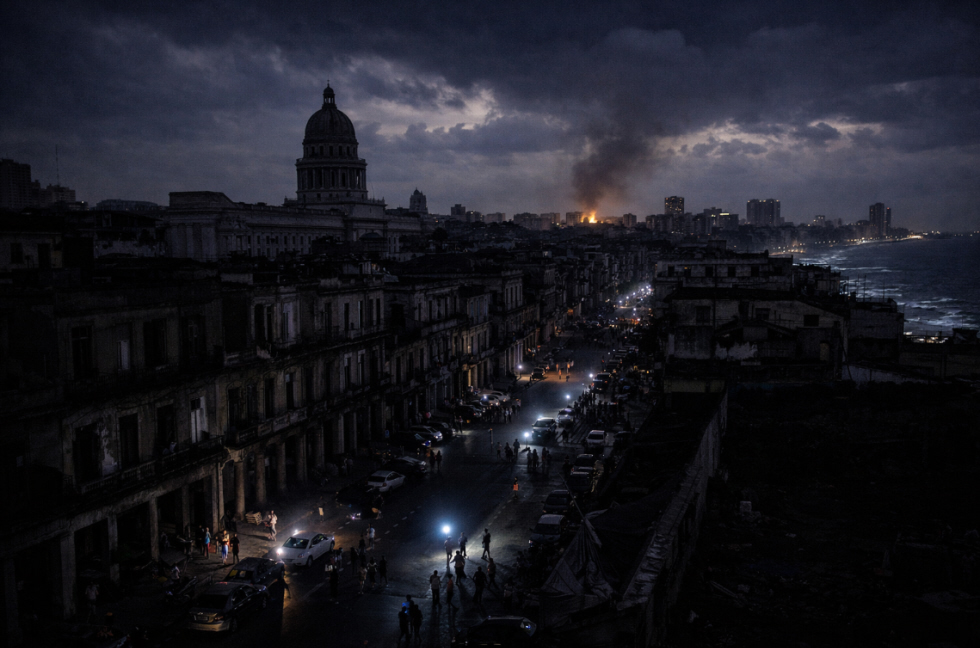
A nationwide blackout plunged Cuba into total darkness on Monday afternoon after the collapse of the national power grid. Millions of residents lost electricity within minutes. The outage affected both major cities and rural areas. The country entered a severe energy emergency with immediate consequences. Authorities confirmed that the electrical system suffered a “full disconnection,” triggering a blackout across the entire island. This type of failure highlights the fragility of the country’s energy infrastructure. Restoring power is expected to be a complex and gradual process. Technicians are working urgently to stabilize the system.
The impact was immediate on hospitals, transportation, and communications. Many facilities had to rely on emergency generators. However, not all institutions have sufficient backup capacity to operate normally. The situation quickly raised concern among the population. Streets in several cities were left completely dark, creating unusual scenes of silence and tension. Businesses were forced to close abruptly, and traffic became chaotic.
The lack of public lighting increased feelings of insecurity. Daily life came to a halt. The blackout also disrupted internet access and digital services. In an increasingly connected society, the loss of communications intensified the overall impact. Many communities were left isolated. Uncertainty spread rapidly across the island. At the same time, the event comes amid rising political tensions that have once again placed Cuba at the center of international attention. Recent statements by U.S. political figures have sparked controversy. These remarks added pressure to an already fragile situation.
The timing is particularly sensitive. Some comments made in the United States regarding Cuba have been interpreted as signals of a more assertive stance. These statements have triggered reactions and debate across different sectors. Analysts believe they contribute to a heightened political tone in the region. The rhetoric adds complexity to the situation. Although no direct connection has been confirmed between the statements and the blackout, the timing has drawn attention. The energy crisis alone represents a significant challenge. However, the political context amplifies its impact. Everything is unfolding during a moment of elevated tension.
Experts point out that Cuba’s power system has faced structural problems for years. A lack of investment and maintenance has weakened the infrastructure. Events like this expose long-standing vulnerabilities. The situation is not entirely unexpected. Power restoration could take hours or even days in some regions. This will depend on the actual condition of the affected facilities.
Authorities are working to gradually stabilize the grid. The priority is to prevent another collapse. Meanwhile, the population is adapting to difficult conditions marked by uncertainty. Access to food, water, and basic services is being affected. Social resilience is once again being tested.
The country faces another critical moment. In this context, Cuba stands at a crossroads where internal challenges intersect with external pressures. The energy crisis adds to an already complex political environment. The coming days will be decisive. The world is closely watching developments on the island.