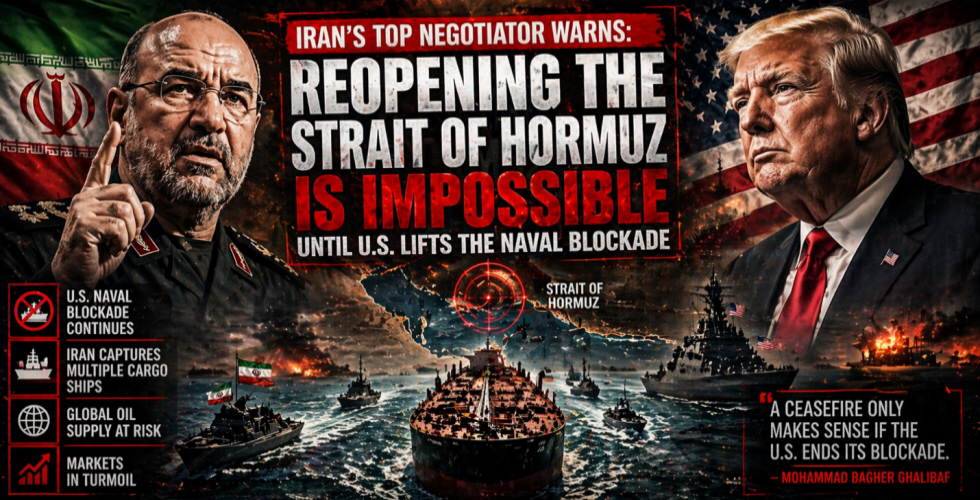
Iran’s top negotiator and parliamentary speaker Mohammad Bagher Ghalibaf has taken a firm position regarding the future of the Strait of Hormuz, declaring that reopening the vital waterway is currently impossible under existing conditions. His remarks come as tensions remain high despite the fragile ceasefire announced between Washington and Tehran. The statement reflects how fragile the diplomatic environment remains. Energy markets reacted immediately. Ghalibaf argued that a true ceasefire cannot exist while the United States maintains what Iran describes as a naval blockade.
Tehran considers the continued military pressure a direct violation of the truce. From the Iranian perspective, negotiations lose legitimacy if economic strangulation continues at sea. This has become the central obstacle to further diplomacy. The Strait of Hormuz is one of the most strategic maritime routes in the world, carrying a significant portion of global oil and gas shipments. Any disruption in its operation immediately affects international markets. For Europe and Asia, the consequences are especially severe. Rising energy costs have already triggered alarm across major economies.
Iranian forces have also increased pressure in the region through actions involving commercial vessels. Reports of ship seizures and confrontations in the strait have intensified fears of escalation. These incidents are being interpreted as both retaliation and strategic signaling. Maritime security has become the front line of the crisis. Washington, meanwhile, continues to insist that maintaining leverage is necessary to secure meaningful negotiations. U.S. officials argue that easing pressure too soon would weaken their position. This has created a diplomatic deadlock where both sides demand concessions first.
The ceasefire survives, but trust remains absent. Pakistan has remained active as a mediator, attempting to keep communication channels open between both governments. However, uncertainty persists over whether another round of formal talks will take place. The political divisions inside Tehran also complicate a unified negotiating position. Time is becoming a decisive factor. Global markets continue to watch the Strait of Hormuz more closely than ever.
Oil prices, shipping routes and insurance costs all reflect the uncertainty surrounding the passage. Investors understand that this is no longer a regional issue alone. The stability of the global economy is directly tied to what happens there.
As long as the blockade remains and diplomatic trust remains broken, reopening Hormuz appears increasingly difficult. The strait has become more than a shipping route—it is now a symbol of strategic control and political leverage. The next steps from Washington and Tehran will shape far more than regional security. They may define the next phase of global economic stability.