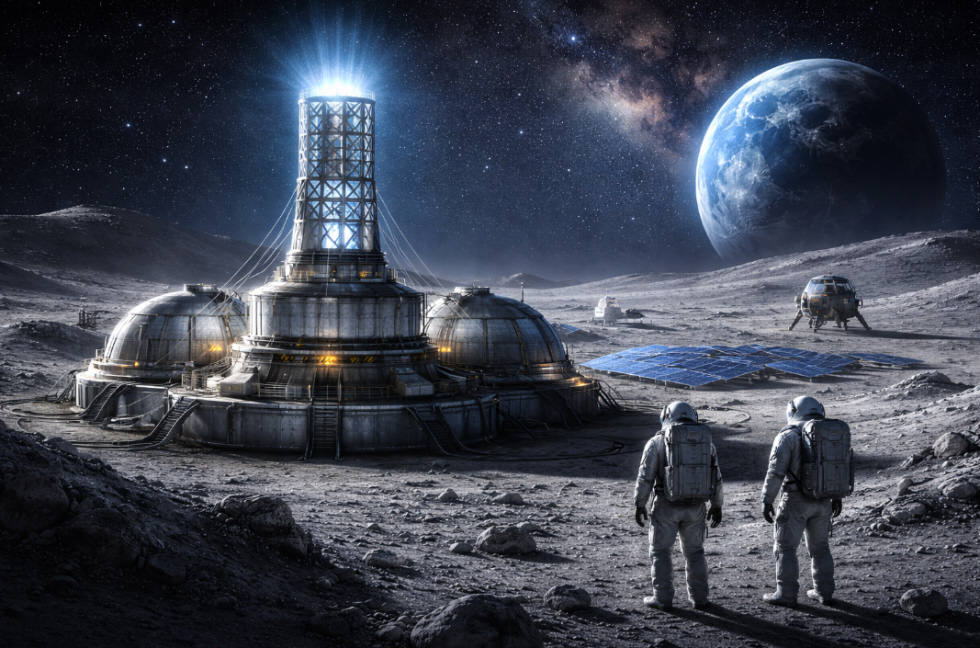
NASA has reaffirmed its intention to develop a nuclear power system on the Moon, a key component of its long-term plan to establish a sustained human presence on Earth’s natural satellite. The initiative is part of a broader strategy that aims not only to return astronauts to the Moon after more than five decades, but also to lay the groundwork for future missions to Mars and beyond.
NASA Administrator Jared Isaacman emphasized that the United States’ objectives extend well beyond a symbolic return. According to his remarks, the agency is focused on building the infrastructure required to remain on the Moon for extended periods, a goal that demands significant technological investment and a reliable, continuous source of energy. Within this framework, nuclear energy is seen as essential. Unlike solar power, which is limited by the Moon’s long cycles of daylight and darkness, a nuclear reactor could provide uninterrupted electricity to support habitats, scientific research, communication systems, and life-support equipment.
The concept of a nuclear reactor on the Moon is not new. NASA has been studying its feasibility for some time, and preliminary plans were made public last year. However, specific technical details—including design, location, and construction timelines—have yet to be disclosed. The project is closely tied to the Artemis program, through which NASA plans to land humans on the Moon again for the first time since the Apollo era.
Unlike earlier missions, Artemis envisions a more permanent presence, with infrastructure designed for long-term operation rather than short visits. Beyond scientific ambitions, the initiative also carries a clear geopolitical dimension. Lunar exploration has become an arena of strategic competition, particularly with China, which is advancing its own ambitious space programs.
Russia has long promoted the idea of nuclear power on the Moon and is currently pursuing joint lunar projects with China. The renewed focus on permanent lunar infrastructure signals a shift in how major space powers approach exploration. The Moon is increasingly viewed not as a final destination, but as a critical stepping stone for humanity’s expansion deeper into the solar system.
As NASA continues to refine its plans, the proposed lunar nuclear reactor could become a cornerstone of the next phase of space exploration, with scientific, technological, and strategic implications reaching far beyond the Moon itself.