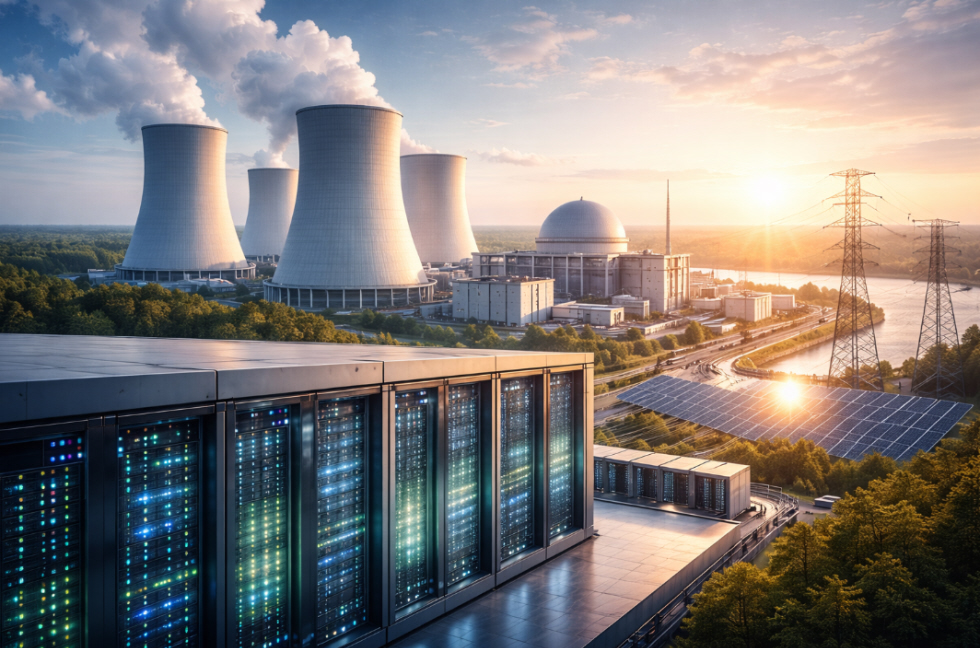
The rapid advancement of artificial intelligence is forcing major technology companies to rethink how they secure a stable, reliable, and long-term energy supply for their data centers. In this context, nuclear energy is once again taking a central role in the United States’ energy strategy. Meta, the parent company of Facebook, has moved in this direction by advancing agreements with companies in the nuclear sector to ensure the electricity required for its artificial intelligence infrastructure.
The initiative aims to expand the capacity of existing power plants while supporting the development of next-generation nuclear technologies. Part of these agreements involves extending the operational lifespan and increasing the output of nuclear facilities already in service in key U.S. states. At the same time, Meta is backing projects focused on modern reactor designs, with the goal of bringing new nuclear plants online in the coming decade.
Interest in next-generation reactors reflects the need for energy sources capable of delivering constant, high-capacity, and low-emission electricity—an essential requirement for data centers that power advanced artificial intelligence systems. Unlike other renewable sources, nuclear energy provides continuous output without dependence on weather conditions. This strategy is not an isolated case.
Other major technology companies are moving in a similar direction, driven by the rapidly growing energy demands of artificial intelligence, cloud computing, and large-scale data processing. The technology sector has become a key force behind the renewed momentum in the nuclear industry. The U.S. government has also signaled strong support for this trend, promoting large-scale investments to strengthen the country’s nuclear infrastructure.
Expanding energy capacity is increasingly viewed as critical not only for technological competitiveness, but also for national security and long-term energy resilience. The revival of nuclear energy represents a significant shift in U.S. energy policy, driven not only by climate considerations but also by the need to sustain growth in strategic sectors such as artificial intelligence and advanced digital services. In this emerging landscape, the intersection of technology, energy, and innovation is redefining energy infrastructure as a foundational pillar of economic and technological development in the decade ahead.