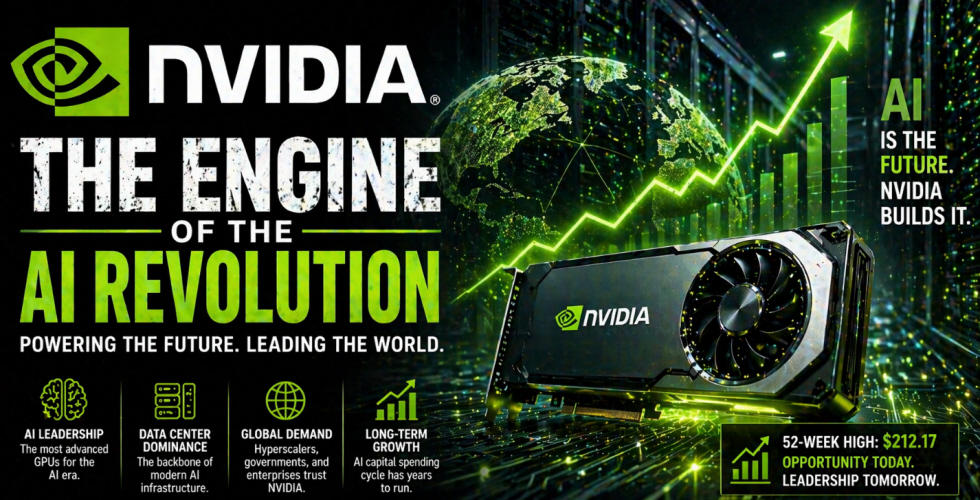
NVDA remains the central pillar of the infrastructure powering the new era of artificial intelligence. Its GPUs and networking systems drive data centers, cloud platforms and government projects competing to dominate the digital future. As the world accelerates its race for computing power, NVIDIA stays at the center of the board. The company no longer sells only chips—it sells strategic capacity.
Its data center division has become the main engine of revenue, far surpassing other traditional areas of the business. Companies like Microsoft, Amazon, Google and Meta continue investing billions to expand their AI model training capacity. Every new phase of that expansion strengthens NVIDIA’s position even more. Demand shows little sign of slowing. Although the stock has pulled back from its recent 52-week high, many investors see that correction as an opportunity rather than a warning sign. The market continues to watch whether the massive AI spending cycle is only beginning or already entering a more mature stage.
For bullish investors, several more years of structural growth may still lie ahead. The bet remains long term. The development of new architectures like Blackwell and the future Rubin platform reinforces that view. NVIDIA is not only dominating the present, but also working to secure the next generation of advanced AI hardware. The company operates with extremely aggressive innovation cycles. In this industry, arriving first often means controlling the market.
Another key factor is its relationship with governments and technological sovereignty. More countries want to build their own national AI capacity, from data centers to digital defense infrastructure. That turns NVIDIA into a geopolitical player as much as a corporate one. Its chips are now part of national security decisions. Export restrictions involving China also keep investors on alert. The tension between Washington and Beijing over advanced semiconductors directly affects expectations for future revenue.
Every regulatory decision can move billions in market valuation. NVIDIA operates inside a global technology war, not just on Wall Street. Despite its high valuation, many analysts believe the company still justifies its premium through growth, margins and near-total dominance in the most profitable segment of the digital revolution. The discussion is no longer whether NVIDIA leads the industry, but how long it can maintain that advantage.
Very few competitors have the scale to challenge it immediately. Investing in NVIDIA today is not simply buying a technology stock. It is a bet on the continuation of the entire global artificial intelligence cycle. As long as the world keeps building data factories, supercomputers and larger models, NVIDIA will remain one of the most watched companies on the planet. In this war, true power is not always in software, but in whoever controls the silicon.