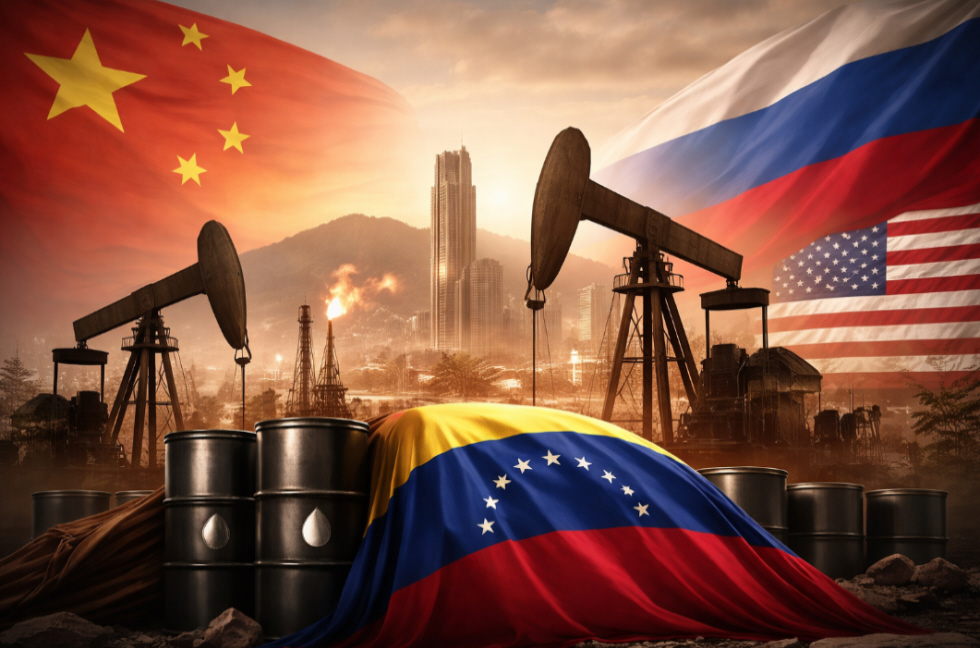
As Venezuela moves into a post-Maduro phase, a common assumption in Washington is that China and Russia will gradually be pushed out of the country. The logic appears simple: with U.S. influence reasserted and a new interim leadership in Caracas, foreign rivals should lose leverage. In reality, this view underestimates how deeply both Beijing and Moscow are embedded in Venezuela and misreads how they are likely to adapt.
Neither China nor Russia is preparing for a clean exit. What lies ahead is not withdrawal, but recalibration. Both powers are shifting away from overt confrontation and toward quiet accommodation, prioritizing the protection of concrete interests over symbolic influence or ideological positioning. China’s position is the most structurally entrenched. Over the past two decades, Beijing has become Venezuela’s most important foreign economic partner, particularly in the energy sector.
Chinese state companies such as Sinopec and CNPC hold major stakes in Venezuelan crude production, and China already operates refineries specifically configured to process Venezuelan oil. Beyond energy, Beijing extended roughly $60 billion in official government-to-government loans, with total exposure approaching $100 billion when broader investments are included. Much of this financing was structured through oil-for-loans agreements, tying repayment directly to crude shipments and binding China’s financial recovery to Venezuela’s production capacity.
While Nicolás Maduro reduced part of this debt before his removal, Venezuela still owes China at least $10 billion, and possibly more. The exact figure remains unclear after years of opaque reporting and disruptions caused by sanctions. What is clear is Beijing’s priority: this is no longer about ideology or political alignment, but about recovering capital and securing long-term supply. Ironically, U.S. efforts to stabilize Venezuela’s oil sector could advance that objective.
President Donald Trump has signaled that oil exports will continue to existing buyers, including China. If U.S. oversight restores production and export volumes, Beijing may finally recoup part of what it is owed. For China, stability under U.S. dominance is preferable to prolonged chaos that blocks repayment entirely. China’s footprint in Venezuela also extends beyond oil. Companies such as Huawei and ZTE have been embedded in the country’s telecommunications infrastructure for years, forming a backbone that would be costly and disruptive to dismantle quickly.
Even a government aligned with Washington would face practical limits in reversing that presence. Russia’s position is narrower but no less strategic. Moscow’s leverage is concentrated in security cooperation, military equipment, and energy partnerships, areas where it can downscale visibility without abandoning influence. Rather than confront
Washington directly, Russia is expected to preserve a low-profile presence focused on safeguarding assets and maintaining optionality. Ultimately, the post-Maduro landscape in Venezuela is unlikely to produce a clean geopolitical reset. Instead, it will reveal a more complex reality: U.S. power reasserted at the top, while China and Russia quietly adapt beneath the surface, embedded not by ideology, but by debt, infrastructure, and long-term strategic